Peinture sous verre
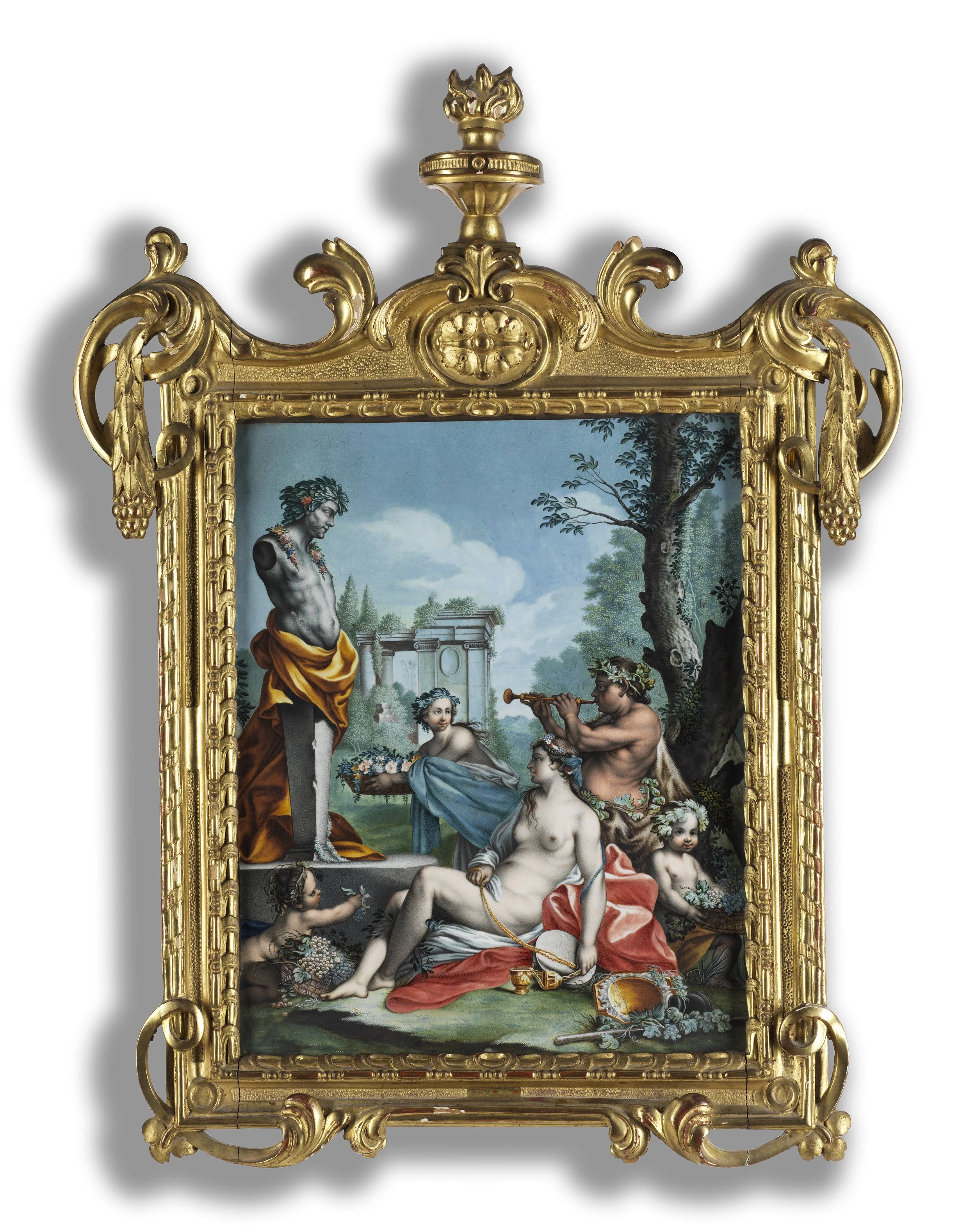
Image size: 41 x 31.5 cm / 16.1 × 12.4 in
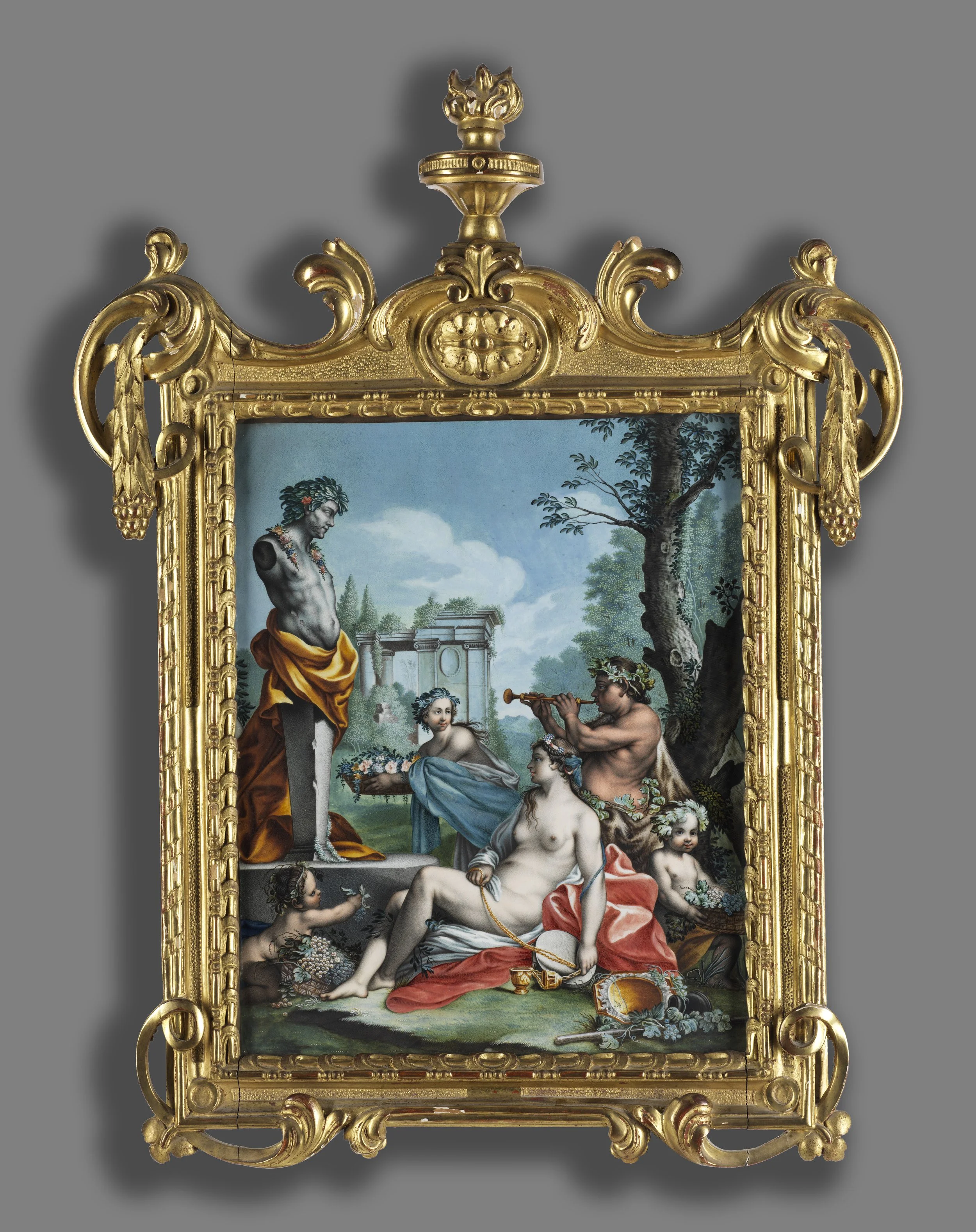
In a carved giltwood frame with fruit decoration
Frame dimensions: 69 x 51 cm / 27.1 × 20 in
Parisian workshops, mid-18th century
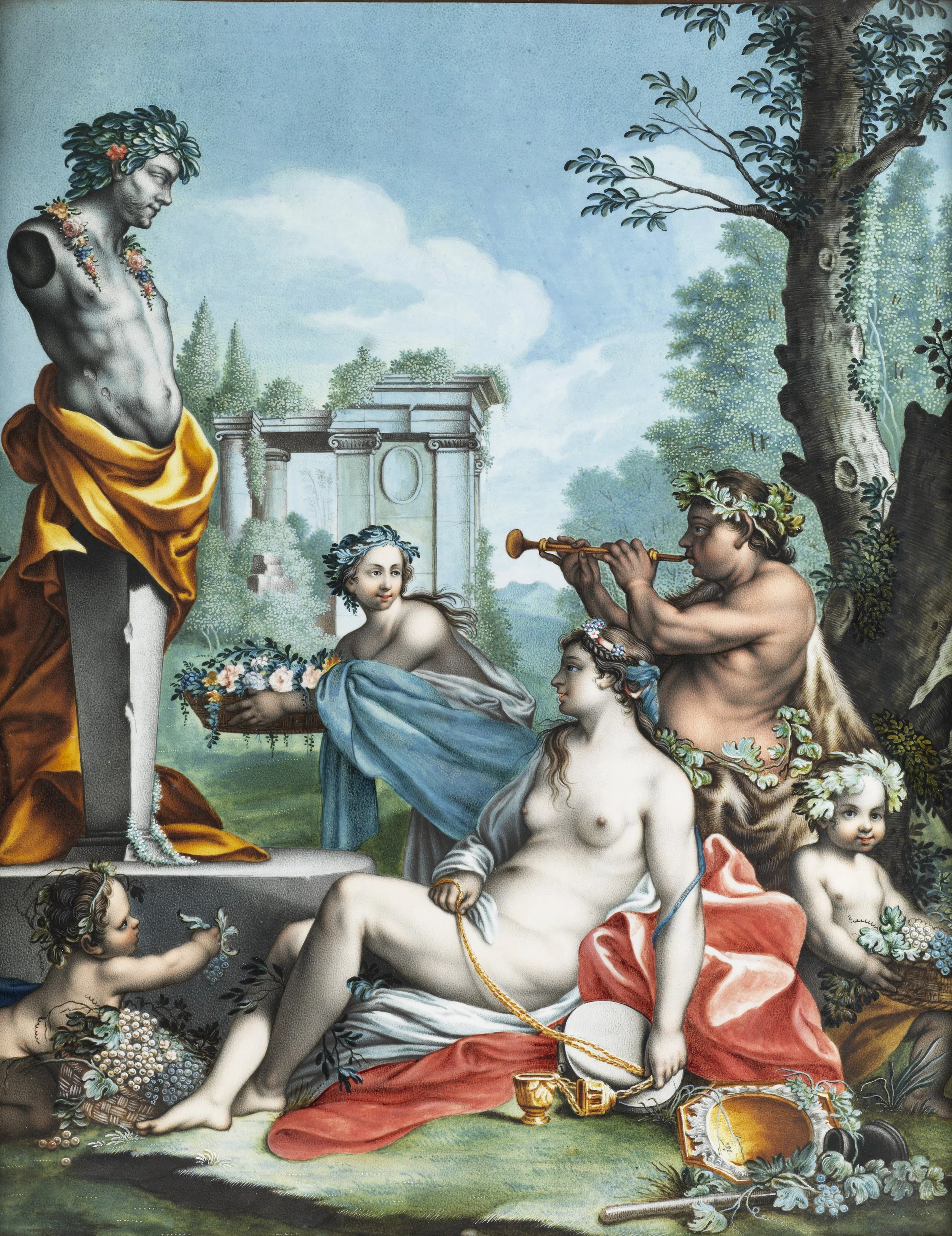
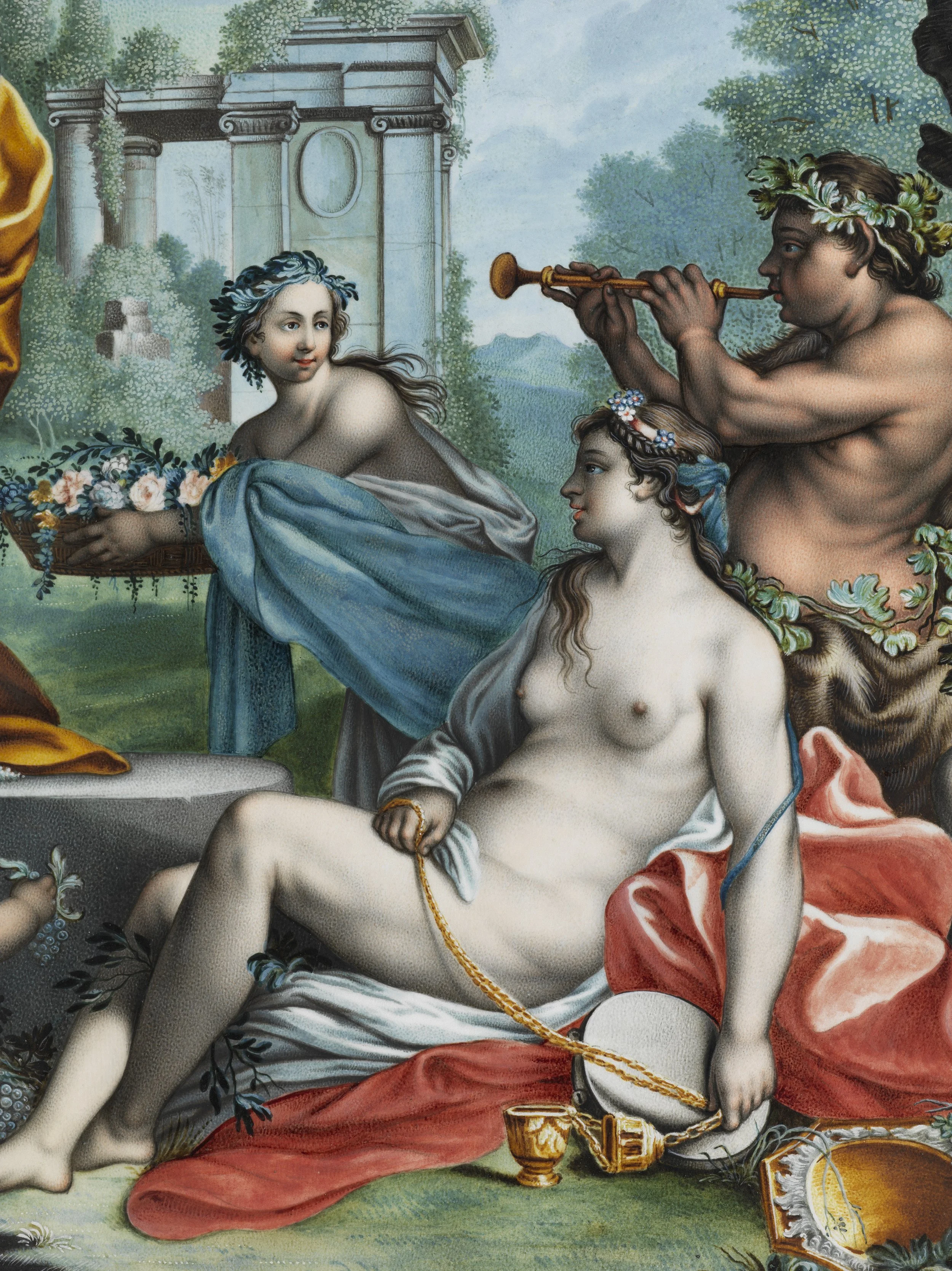
Executed in brilliant colours with the utmost refinement. In a rural setting, the painting depicts a sacrificial festival in honour of Pan, the god of shepherds. On the left, on a plinth, stands a herm with a bust of Pan, crowned with a wreath of laurel leaves and adorned with garlands of flowers. Staged as an ancient cult image, the arms are only fragmentarily visible, and the torso is linked to the pillar by a shimmering gold cloth. Grouped around this cult image are the figures paying homage: a reclining, half-draped young woman holding a censer of incense in her hands, beside her a vessel for libations. Another woman hurries over with a basket of blossoms, while a figure of Bacchus — whose entourage Pan belonged to — blows an aulos as two child figures handle bunches of grapes.
The figure of Pan played an important role in the Arcadian fertility cult, which was widespread chiefly among shepherds. The centre of this orgiastic cult, associated with sexual abandon, dance and song, was Hermes. Initially, he was not regarded as a god but was rather identified with the totemistic power of a phallic post or mound. Gradually, as the vital powers of Hermes were brought together and his divine protection of boundaries, roads and travellers was acknowledged, the phallic posts by the wayside were replaced by herms — square pillars that widen towards the top and are crowned with a bust.
The extraordinarily fine execution in polychrome reverse glass painting is based on a mirrored engraving by Louis Simon Lempereur (1728–1808), which in turn was made after a painting by Jean-Baptiste Marie Pierre (1714–1789).
An impression of the engraving is held at the Fine Arts Museums of San Francisco (inventory number 1963.30.30813).
Comparative Literature:
Lesur, Nicolas; Aaron, Olivier: Jean-Baptiste Marie Pierre (1714–1789). Premier peintre du roi. Paris, 2009.
______________
Sacrificium in Honore Panos
Peinture sous verre
Bildfeld: 41 x 31,5 cm
In vergoldetem geschnitztem Rahmen mit fruktaler Zier
Rahmenmaße: 69 x 51 cm
Pariser Werkstätten, Mitte 18. Jahrhundert
In leuchtenden Farben in hochfeiner Ausführung. In ländlicher Umgebung Darstellung eines Opferfestes zu Ehren des Hirtengottes Pan. Links erhebt sich auf einem Sockel eine Herme al Pansbüste mit Lorbeerblattkranz bekrönt und von Blütengirlanden geschmückt. Als antikes Kultbild insziniert sind die Arme nur fragmentarisch zu sehen, der Rumpf wird von einem Goldglänzenden Tuch mit dem Pfeiler verbunden. Um dieses Kultbild gruppieren sich die vereehrenden Personen nämlich eine lagernde halb entblösste junge Frau ihn ihren Händen einen Weihrauchkessel haltend, neben ihr ein Libationsgefäß. Eine weitere Frau eilt mit einem Blütenkorb herbei, eine Bacchusfigur, zu deren Gefolge Pan gehörte, bläst einen Aulos während zwei Kindsfiguren mit Weintrauben hantieren. Die Figur des Pan spielte eine wichtige Rolle im arkadischen Fruchtbarkeitskult, der vor allem unter den Hirten verbreitet war. Mittelpunkt des orgiastischen Kultes, der mit sexueller Ausschweifung, Tanz und Gesang verbunden war, war Hermes. Anfangs wurde er nicht als Gott betrachtet, sondern eher mit der totemistischen Macht eines phallischen Pfahls oder Hügels gleichgesetzt. Allmählich wurden, mit der Verbindung der vitalen Kräfte des Hermes und der Anerkennung seines göttlichen Schutzes über Grenzen, Wege und Reisende, die Weges phallischen Pfähle durch Hermen ersetzt – viereckige Pfeiler, die sich nach oben verbreitern und mit einer Büste gekrönt sind. Die ungeheuer feine Umsetzung in polychrom gestalteter Hinterglasmalerei basiert auf einem seitenverkehrten Stich von Louis Simon Lempereur (1728 – 1808), welcher nach einem Gemälde von Jean – Baptiste Marie Pierre (1714 – 1789) entstand.
Ein Exemplar des Stiches wird im Fine Arts Museums of San Francisco (Inventarnummer 1963.30.30813) verwahrt.
Vgl. Literatur:
Lesur, Nicolas; Aaron, Olivier: Jean-Baptiste Marie Pierre (1714–1789). Premier peintre du roi. Paris, 2009.